Skip to content Skip to footer

Uncategorized

Uncategorized

Turf360 Now Available Free for All Queensland Turf Growers

Turf Queensland is excited to announce that Turf360, our industry-leading best management practice platform, is now available to all Queensland turf growers free of charge.

Turf360 is designed to help growers improve farm management, adopt sustainable practices, strengthen biosecurity, and build more resilient, professional operations. With practical modules covering water efficiency, soil health, pest and disease management, and Australia’s first turf-specific RIFA module, Turf360 gives growers the tools to continuously improve their business and demonstrate their commitment to best practice.

For growers, this means access to a structured, easy-to-use platform that supports smarter decision-making, improved operational efficiency, and stronger business outcomes — all at no cost.

The program is third-party accredited, so growers who want to take their benchmarking to the next level, verify their practices, and receive formal recognition for their achievements can do so through the accreditation process. While accreditation comes at a cost, it provides independent verification and formal industry recognition.

Turf360 is part of Turf Queensland’s ongoing commitment to support growers, drive sustainability, and strengthen the industry. Growers interested in joining or learning more can get in touch with Turf Queensland today to start using Turf360 and be part of the growing network of accredited, forward-thinking turf producers.

The Farm Business Resilience Program is jointly funded through the Australian Government’s Future Drought Fund and the Queensland Government’s Drought and Climate Adaptation Program.

Continue reading

Uncategorized

FIRE ANT NEWS

Recent national media coverage claiming that Australia has lost the war against one of the world’s most invasive pests is not true.

The truth is that our program is on track to rid our country of the ‘super pest’ once and for all.

Just two years into the program’s 10-year plan, residents in Lockyer Valley, Scenic Rim and parts of Ipswich City local government area are telling us the strategy is working.

Our eyes on the ground are telling us our efforts to eradicate fire ants in the west of Brisbane are paying off. This is positive news for the program, for Queensland and for Australia.

There is also scientific evidence that the treatment is weakening genetic diversity of the ants, increasing the pressure on this pest.

The program’s finite resources over ten years are focussed on eradication strategies, working from west to east — from the western boundary of the infestation, through Ipswich, Logan and ending in Redlands.

Best available advice to the program indicated the strategy moving from west to east, taking a systematic approach, would give us the best chance of eradicating the pest from our backyards once and for all.

Containment strategies are in place on the other boundaries, and suppression methods are used elsewhere within the operational boundary to minimise the spread of fire ants until eradication strategies can be applied.

Since the program began, Australia has eradicated five separate incursions of fire ants, including a population spread over 8,000 hectares at the Port of Brisbane. As the world’s largest eradication of any ant species continues, the eyes of the world are on Australia.

We understand that’s little comfort to those residents across South East Queensland who see fire ants in their backyards and neighbourhoods, but we haven’t forgotten about you.

To some in the suburbs not currently the focus of eradication, fire ant populations will be increasing. This is expected and reports from the community are vitally important to allow us to prioritise our suppression treatments in your area.

Without the efforts of our program, fire ants could be north to Mackay, south to Sydney and west to Charleville by now.

Graeme Dudgeon

General Manager
National Red Imported Fire Ant Eradication Program

10-year fire ant eradication plan

We are now in the second year of our comprehensive 10-year eradication plan to find, contain and eradicate fire ants in South East Queensland.

We have almost completed bait treatment along the western boundary of the fire ant containment area in the Lockyer Valley, Scenic Rim and parts of the Ipswich local government area and our efforts to eradicate the ‘super pest’ appear to be paying off. Residents in the area are telling us “there used to be fire ants, now there are none.”

We are supported by a National Red Imported Fire Ant Eradication Program (SEQ) steering committee  which provides guidance and support, and monitors our progress against targets to ensure we are successful.

Read more about our 10-year National Red Imported Fire Ant Eradication plan.

Listen to what our farmers out west have to say: https://www.youtube.com/watch?v=-4xYNpQ38tI


Continue reading

Member AlertsTurf AlertsUncategorized

Turf Industry Forum – WorkCover Website article on Agriculture microsite

On Tuesday, 14 May 2019 a turf industry forum was organised by Turf Queensland, bringing together the three main disciplines namely turf production, sports fields and golf courses. The forum was highly successful with 52 delegates across all areas giving the event a positive response.

Industry experts provided delegates with up to date information on a range of topics from workplace health and safety requirements to health and wellbeing.

Below is a list of the speakers with links to their presentations and recordings.

If you have any questions, please contact Jim Vaughan at Turf Queensland:

Phone 07 3822 8662https://www.worksafe.qld.gov.au/agriculture

Mobile: 0407 131 025

Email: jim@qtpa.com.au


Workplace health and safety compliance requirements

Kristie Smith, Senior Inspector in the Agriculture Unit
Workplace Health and Safety Queensland


Return to work – impact on people and premium
Evan Coombs, Customer Advisor Agriculture Industry, WorkCover Queensland

Natural Turf – Cooling the Urban Heat Island

Jim Vaughan, Turf Queensland


Mental Health

Peter ???, Lifeline


Managing risks of heat stress
Carolyn Topping, A/Director Occupational Health & Hygiene, Workplace Health and Safety Queensland


Transition to Bifenthrin – Chemical treatment of fire ants

Germán Perlaza, Department of Agriculture and Fisheries


Continue reading

Member AlertsTurf AlertsUncategorized

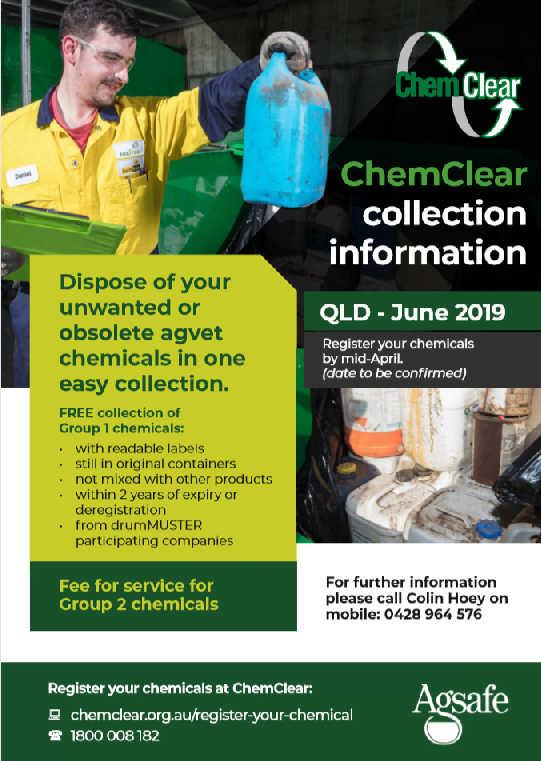
ChemClear’s upcoming agvet chemical collection scheduled for Queensland in June 2019.

Registrations are open until 19 April.

Queensland property owners can register their unwanted or obsolete  agricultural and veterinary chemicals for Agsafe’s ChemClear collection which is hitting the road in June.

ChemClear is a non-profit collection service for users of agricultural and veterinary chemicals, offering an environmentally sound solution to disposing of unwanted or obsolete farm chemicals.

A collection has been scheduled for Queensland, commencing in June 2019 and chemical users have until 19 April to register their unwanted chemicals.

PLEASE SEE FLYER BELOW

We have created community engagement materials prepared especially for Queensland Re-sellers, Industry Groups and Councils to display in public areas, waste collection and recycling stations, libraries and customer service areas.

Bookings are essential with ChemClear and can be made by contacting 1800 008 182 or by using the online registration portal. You can Download a ChemClear Inventory Form to assist you with your registration.

The retrieval vehicle contracted by ChemClear will be collecting from an allocated site in each shire council in which a registration has been received. Registered users will be contacted with information about the time and location of their scheduled collection.ChemClear flyer

For further information please call Colin Hoey on mobile: 0428 964 576.

Continue reading

Member AlertsTurf AlertsUncategorized

THE DIFFERENCE BETWEEN ACCREDITATION and CERTIFICATION

Probably the most knowledgeable agronomic expert in Australia is “Peter McMaugh”. He has recently written an article that appeared in the Australian Turfgrass Management magazine qualifying certification. Below we have adapted some of that for the benefit of our members.

He states that “In its simplest terms certification as a guarantee. It guarantees that what you what you order is what you get, and that what is produced under tightly controlled conditions (rules) are protected and enforced by regular independent inspections”.

He also qualifies; that to date in Australia there has been no genuine fully-fledged “true” Certification scheme for vegetatively propagated turfgrass varieties.

PBR (Plant Breeders Rights) is the protection of the owner of the rights and not the protection of the end user. Under the BR at when a person or entity is awarded ownership of a plant variety, there is an obligation that requires access license holders to pure stock. By two providers can result in the loss of license.

The characteristics of ‘Certification’ means that you cannot have a ‘certified; farm producing ‘certified’ products you can only have certified paddocks, clearly identified by GPS coordinates which contain a specific quantity of a specific grass variety.

This is where Certification shows clear differences from schemes of Accreditation.

Accreditation: an Accredited Turf farm should produce reliable good-quality turf on a consistent basis in line with all the appropriate regulations and legislation covering, but not limited to; business and company processes, property mapping, soil and help properties, water and irrigation system performance, pests, weed and disease management, cutting and installation processes, waste reduction, energy use efficiency, business operations and business management (PBR/Certification), workplace health and safety, communications and ongoing performance measurement.

The Turf Queensland Turf Accreditation Program is a third-party audited process that provides the end user with the knowledge that they are receiving products managed to a best practice standard thus reducing risk.

Certification: ensures that you are getting the best quality of the variety of grass you have selected to suit your needs and at time of leaving the property is guaranteed 100% pure to that variety and is being managed by the producer. Certification ensures that the Turf producer is managing any contamination and quality of the species. It does not involve the Accreditation process of business and farm management processes.

It is important to understand the difference between the definitions of Certification and Accreditation.

Continue reading

Member AlertsTurf AlertsUncategorized

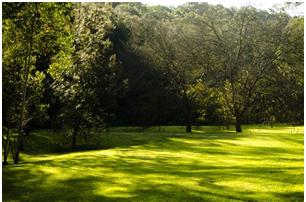
Shade Areas and Natural Turfgrass

The following has been adapted from a Sod U (USA) blog for the benefit of natural turfgrass users.

Many people ask the question is my lawn to shady? And how much sunlight do I need to ensure a healthy lawn?

Growing grass in shady conditions is a common challenge for many home owners.

Growing Grass in Shaded Areas

Growing grass in shady conditions is a common challenge for many homeowners. It is common knowledge that grass cannot be grown in total shade (like all plants, grass requires sunlight to photosynthesize), but the questions “how much shade is too much?” or “what is the least amount of sunlight required to grow a healthy lawn?” or “do I need special climatic conditions and soils”? These are asked very frequently.

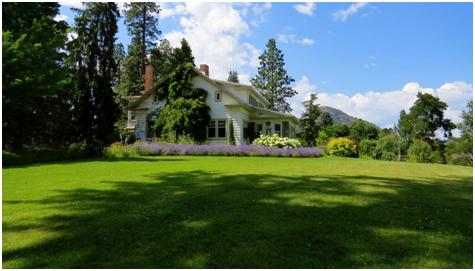
The short and simple answer to this question is that in order to survive, a lawn using certain shade tolerant varieties will need at least 4 hours of direct sunlight, preferably from 10 am to 2 pm. To thrive, a lawn needs even more sunlight if possible.
Managing Shady Landscapes

The 5 major factors to consider when managing shady landscapes in Queensland and Northern Territory are;

  • The kind of shade challenge the lawn is facing?
  • What are the soil conditions?
  • What are the climatic conditions (how many hours of sunlight/rain/wear)?
  • What are the shade tolerant grass options available in the region?
  • Fungal disease in shady landscapes.

Different Kinds of Shade & Changing Shade

Not all shade is equal, and not all shade is permanent. Filtered sunlight (partial shade) from a tree is preferable to zero sunlight (complete shade) from a building or other large, permanent structure. Trees may be thinned or removed while buildings cannot be altered to accommodate the needs of a lawn. It is important to consider that as a landscape matures and trees grow larger canopies, previously healthy lawns may decline with diminished sunlight however some of these can be managed. After taking the steps of understanding and managing (if possible) the source of shade, the next factor to consider is the shade tolerant grass options available in your specific region both should be discussed with your Turf Queensland producer there are many different species and varieties available.

Comparative Shade Tolerance of Different Grass Species and Cultivars in Australia

Listed below are grass species recommended in Australia for shade tolerance.

  1. Buffalo grass
  2. Zoysia grass
  3. Kikuyu grass
  4. Seashore Paspalum
  5. Couch grass.

The shade tolerant grass species available for use will depend on where you live, climate, soils wear and amount of shade. In warm season areas of Queensland and Northern Territory, Buffalo grass is the most shade tolerant, followed by Zoysia grass (see above).

Comparative Shade Tolerance of Different Cultivars

A cultivar is a specific kind of grass within a species. For example, Palmetto and Sir Walter are Buffalo grasses, but different cultivars. While both are shade tolerant, Palmetto has shown to be one of the most shade tolerant cultivars among all Buffalo grasses.

Within Zoysia grasses, a general guideline to remember is the finer the leaf blade, the more shade tolerant the cultivar. Couch is the least shade tolerant of all grass species, but there are some shade tolerant couch grass cultivars.

Whichever grass you choose, a tip for maintaining shade-tolerant varieties is to mow a bit higher than the recommended mowing height. The extra height will provide a greater surface area for the grass to photosynthesize the reduced sunlight it receives in shady conditions. Always talk with a professional quality Turf Queensland producer for further advice to suit the climate and soils of your area.

A Word About Disease

Any turfgrass grown in wet, shady environments is prone to fungal disease. Shade tolerant grasses often struggle or die from disease pressure, not necessarily from lack of sunlight. When selecting a shade tolerant grass to grow in a shady landscape, be sure to budget for several applications of systemic fungicide per year. Additionally, note that to avoid disease it is best to water less in shaded areas compared to areas that receive full sun.

Nothing Beats Quality Professional Advice

Due to the varying conditions experienced in the Queensland and Northern Territory tropical and subtropical climates, it is recommended you contact your closest Turf Queensland member to obtain their input into the right grasses for your project. www.qtpa.com.au


Continue reading

Uncategorized

Turf QLD Industry Alert |Townsville Remains in Level 3 Water Restrictions

Townsville Remains in Level 3 Water Restrictions

Turf Queensland continues to watch the water restrictions applying in the Townsville area. Pumping water from the Burdekin at this time is filling a small gap. We all hope that the wet season is kind to our industry members and partners in the Townsville area.

Guaranteeing Townsville‘s water supply continues to take priority in the Townsville City Budget 2017/18 with funding for the purchase and pumping of water from the Burdekin.

The Townsville City Council has allocated $5.5 million for the purchase and pumping of 20,000 Mega litres of water, the equivalent of five months of continual supply.

Importantly Mayor Cr Jenny Hill said the recent funding guarantees from both the Queensland Government and LNP Opposition to fully fund the infrastructure to solve Townsville’s water security solution would save a huge additional capital cost.

“The funding guarantee takes a huge pressure off council in terms of potential capital costs and vindicates the work we have done through the Water Taskforce to make water security a priority for government,” Cr Hill said.

“That means our big focus in the Budget is on making sure the city has a guaranteed water to take us into next year should the drought continue.

“The budget will fund five months of pumping that combined with reserves in the dams and Level 3 water restrictions, will secure the city’s water supply well into next year even without rain. “While we were only required to pump for around three months this year, we’re making sure we have a plan in place that covers every contingency for our community.

“Pumping water to Townsville comes at a substantial cost, but the savings and efficiencies we are achieving right across council means we are able to absorb those costs without having to pass them on to ratepayers. Dam levels of 15% will trigger pumping action.

“We will also be working with the community on a range of water conservation measures and incentives to make our water stretch further.

Continue reading

Uncategorized

Turf QLD Industry Alert |Agriculture mobile plant roll-over fatalities

Agriculture mobile plant roll-over fatalities

In December 2017, a worker on a Tamborine Mountain avocado farm was killed when a single seat ride on mower being driven by another worker rolled over on a steep slope and crushed her.

A few weeks before, a worker was killed when the tractor he was driving went over the edge of a steep embankment on a banana farm in North Queensland. He was attempting a U-turn on a road when it appears he drove over the embankment and was thrown or jumped from the tractor. Although there were no witnesses, the injuries he sustained indicate the tractor rolled over him.

Environmental conditions may have contributed to the incident as it had been raining in the preceding days which left the road muddy and boggy. The tractor was fitted with a roll over protective system (ROPS) but was not fitted with a seatbelt.

Both investigations are continuing.

Preventing a similar incident

Tractors and other items of agricultural mobile plant are safe when operated properly, however, like any equipment, they become dangerous if used incorrectly. Before operating them, the person conducting a business or undertaking (PCBU) must ensure:

  • the vehicle selected is the right vehicle for the task
  • weather and ground conditions have been assessed
  • a ROPS that complies with AS/NZ1636.1-1996 is fitted to tractors in accordance with WHS Regulation s216 Roll-over protection on tractors
  • a seat belt is worn where fitted
  • the manufacturer’s operating instructions have been read and are followed. For older items of mobile plant where operating instructions are not available, operational procedures and instructions for use should be developed by a competent person.

When operating mobile plant:

  • ensure it is driven to suit the environmental conditions and slow enough to retain control in unexpected circumstances
  • reduce speed before turning or applying brakes
  • use as wide a wheel track as possible when working on hillsides and sloping ground
  • descend slopes cautiously, keeping the tractor in low gear to allow motor compression to act as a brake. Watch out for ditches, embankments, and depressions – unstable banks can cause overturns
  • do not park on a steep slope
  • ensure the park brake is on and operating effectively before dismounting
  • if towing a trailer, ensure the load is evenly balanced, well secured and you operate at a lower speed

Statistics

Since 2012, Workplace Health and Safety Queensland has issued 60 improvement and 35 prohibition notices for risks associated with guarding, roll-over protection, falling objects protection, maintenance and safe plant. There have been 20 workers’ compensation claims accepted for injuries caused by tractors rolling over or hitting people in agriculture, construction and other industries.

Prosecutions and compliance

In 2014, a company was fined $70,000 after a worker was killed while performing scrub pulling using two tractors connected by a chain. One of the tractors had mechanical problems and stopped. The worker got off the tractor to investigate but the second tractor continued on, pulling the first tractor over the worker. There was no communication system in place between the tractors.

Also in 2014, a company was fined $35,000 after a worker sustained fractured ribs and internal injuries when the tractor he was operating failed to navigate a bend in a farm road and drove over an embankment. He was not wearing the fitted seatbelt and was thrown out and run over by the tractor.

More information

Managing risks of plant in the workplace Code of Practice 2013 (PDF, 1.1 MB)
Fact sheet: Tractor safety precautions
WHSQ Agriculture: Machinery and Equipment


Continue reading